Some
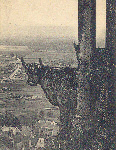
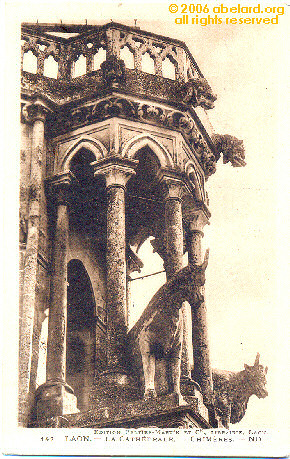
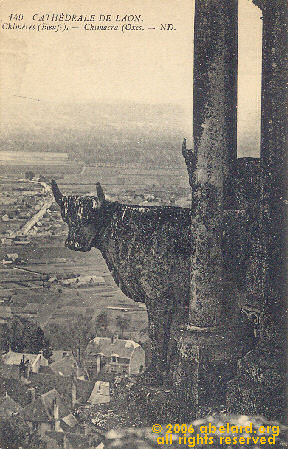
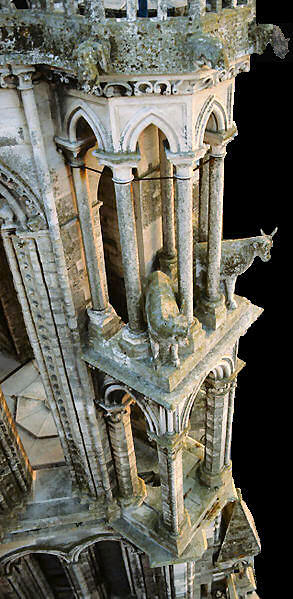
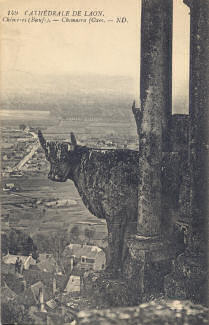
of the sixteen statues of bullocks
on Laon cathedral (circa 1905)
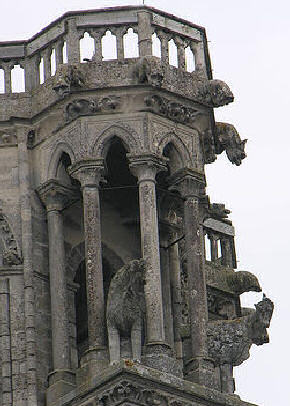
A
similar view in September 2005 Image
credit: AEngineer
Laon cathedral
sits on a high, steep hump of limestone in the midst of
the rolling, northern plain of the French wheat belt.
It is a beautiful cathedral, in a beautiful position;
and badly neglected like so many French public monuments,
being damaged by the ravages of pollution. The two images
above show this clearly. The nearest bullock has now lost
its head, the other animals and floral carvings are badly
decayed, while the top balustrade is cased in planking,
fixed with bolts, to prevent it falling further apart.[It
is possible that the decay had already started at the
time of the earlier picture, the top of the balustrade
looks as if it may be secured by a plank.]
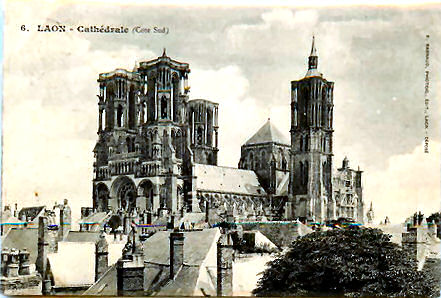
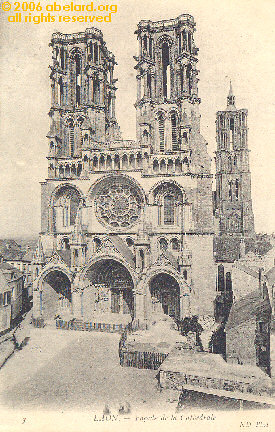
Many of the cathedrals started with plans for a Christmas cake of towers and spires, but usually the builders ran out of enthusiasm and money before the original plans were completed. However, at Laon the builders have made at least a good effort with five towers: the two wonderful constructions on the west facade, then the two rather less ambitious towers at the western side of the transepts, and lastly the stubby effort over the crossing of transepts and nave. This last never did end up with a leaping spire.
buttresses and tribunes
Laon is one of the earliest
gothic cathedrals, and as such it is transitional
in its design. It does not have all of the recognised
attributes of the fully-flowered gothic cathedrals. At
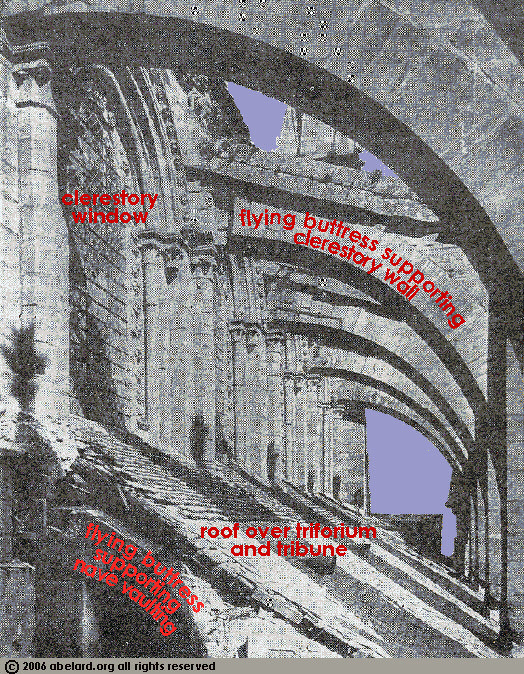
Laon, the buttresses are not fully exposed, in contrast to the glories of buttressing at Le Mans and Bourges.
Flying buttresses at Laon
cathedral [image corresponds to shaded area in diagram below]
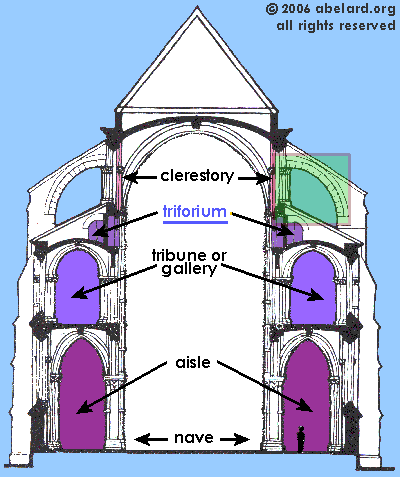
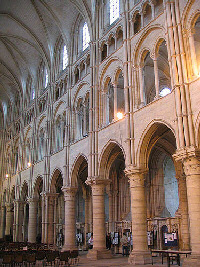
Laon cathedral has an upper tribune gallery that helps
constrain the high nave walls from bulging outwards.
Cross-section of Laon cathedral
nave, showing the unusual four-tier construction
a ‘barn’ church
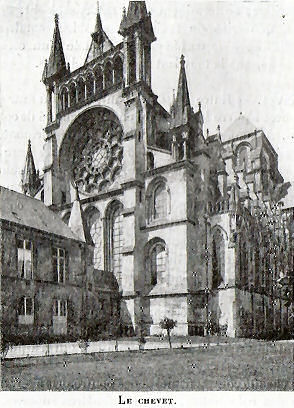
You will see that later, for example at Bourges, the second storey of the apse was inset and the side aisle had become taller. Instead of a tribune, the second storey glass now shone down on the main church, rather than being obscured in the tribune. Laon also differs in that it is the only other ‘major’ French cathedral that has a square east end, like the barn church at Poitiers.
chevet, Laon cathedral
These two cathedrals list high among my favourites for their peace and quiet dignity. Unlike many of the widely known cathedral stars, Laon and Poitiers cathedrals are not overwhelmed to the same degree by tourists. Laon cathedral also has advanced sexpartite vaults in the nave. With its square apse, the bays of the nave march the whole length of the cathedral, giving an open vista of over 100 metres.
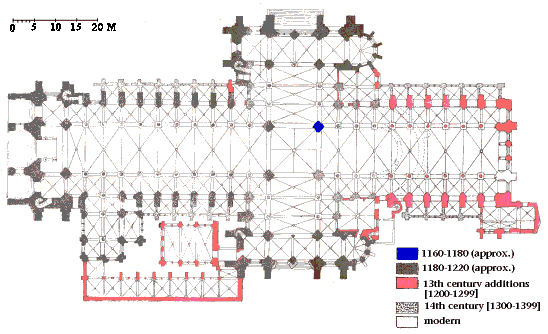
Plan of Laon cathedral
why the oxen?
There are various suggestions why sixteen bullocks are
included on the twin west towers of the cathedral exterior.
Twelfth century legend has it that, when the earlier church
was being built, a haulage team taking equipment to the
foot of the cathedral building works just could not climb
up the hill. Suddenly, they saw their team had been reinforced
by a bullock who, once the providential mission was completed,
disappeared as mysteriously as it had appeared. It is
said that the famous bullocks were added to the towers
in memory of this miraculous intervention. However, this
legend apparently relates to the restoration works of
the previous church, burnt down in 1112. More prosaic
is that the bullocks glorify the enormous labour done
by these sturdy helpers of the thirteenth century architect
when building the current cathedral.[1]
After the Revolution [1789 on] the bishopric of Laon
was removed, so the cathedral became merely the local
parish church. Nowadays, there is no hesitation in calling
this building a cathedral.
West facade
of Laon cathedral
(circa 1920s)
Bullocks near the top of one of two towers on the West facade
of Laon cathedral (circa 1930s)
three-part portal at Laon cathedral
stained glass windows - the roses
Click
on thumbnail images below to go to larger image versions
four tiers of colonnades
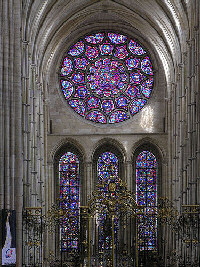
East rose and lancets
credits on page of full
versions, as necessary
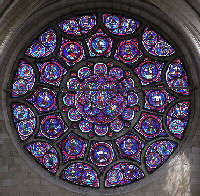
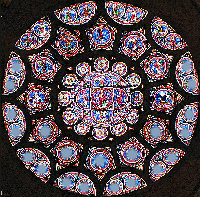
East rose West rose
North rose
Being an early Gothic cathedral,
Laon has less glass compared to later buildings. The glass
is mostly original thirteenth century stained glass (with
some 19th century ‘restorations’).
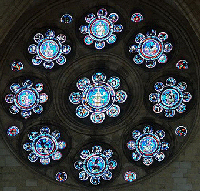
There are four rose windows - east, west, north, south.
The east facade, above the main altar, has a large rose
window, together with three large lancets below. The west rose window matches the east one in its
structure. The rose window in the
north transept is filled with medallions. The south window is more interesting for its structure
than for its glass.
Sadly, the west rose is partially hidden by the organ. The west and east roses are of very similar patterns, varying only at the centre as can be seen on the enlargements.
The east rose was dedicated to the glorification of Mary, who is shown
in the centre crowned and sitting on a throne, carrying
baby Jesus and holding in her right hand the mystical
rose, a flaming scarlet flower. To her sides, are two
prostrated angels, their hands joined/reaching, while
higher up, two other angels sing praises/spread incense.
Above her are shown: to the right, the prophet Isaiah
(his name is on a scroll) who announced that Jesus would
be born from a virgin; to the left, John the Baptist carrying
the holy lamb.
The twelve medallions in the first circle represent the
apostles, sitting on rainbows, barefoot and with haloes.
Their names are written on the banner that each is holding
in the right hand, they carry a book in the left. The
twenty-four medallions of the second circle feature the
Elders of the Revelations/Apocalypse, also sitting on
rainbows, with crowned heads. They carry a phial, symbolising
the prayers of the saints, and in the other hand a musical
instrument: viol, rote***, harp, tambourine, psalterion***.
The north rose contains scenes representing the sciences as understood
and practiced in the thirteenth century - the trivium and the quadrivium - the sciences and the liberal arts.
Only Geometry, Arithmetic, Dialectic and Astronomy are
original glass. The others were remade in 1865 [some say
1856], copying statues from the west facade.
The young women sit on benches: Philosophy in the centre,
then going clockwise from twelve o’clock - Rhetoric
writing on a tablet on her knees; Grammar, with the rods
with which she threatens the little children seated at
her feet; Dialectic; Astronomy, holding a bushel [8 gal,
36.4 ltr] for observing the stars by reflection when filled
with water, or simply to recall that, at that time, this
science fixed the dates for sowing; Medicine; Geometry
and Music.[It is uncertain whether the window is as it
was originally, because Philosophy, Rhetoric, Medicine
and Music were missing before the 19th century restoration.]
The current cathedral building was completed in 1230,
replacing the previous church destroyed by fire. There
are a few carved pieces apparently from the original
building in the local Laon town museum.
stained glass windows - the lancets
On the East facade [1], the three lancets,
still with their original glass, illustrate:
Right lancet
24 yoked medallions representing
the life of Mary and the childhood of Jesus, sometimes
on two neighbouring medallions [part of a Biblia
Pauperum]
1 the Annunciation
2 The Visitation
3 & 4 The Nativity
5 & 6 The annunciation to the shepherds
7 & 8 The adoration of the Wise Men
9 & 10 The presentation to the Temple and the
purification of Mary
11 The fleece of Gedeon
12 The burning bush
13 & 14 The flight into Egypt
15 & 16 The return of the Wise Men
17 & 18 Daniel prophesying the fall of the idols
[‘concordant’ item from the Old Testament]
19 The sacrifice of Abel and of Cain [‘concordant’
item from the Old Testament]
20 The presentation of Mary to the Temple
21 & 22 The massacre of the innocents
Central lancet
This follows the life of Jesus from his entrance into
Jerusalem until the Ascension.
There are a series of five four-lobed medallions that
alternate with five circular medallions.
Some have several scenes
1 The triumphal entrance into Jerusalem
2 The Last Supper
3 The washing of feet
4 Jesus in the Garden of Olives
5 The kiss of Judas
6 Jesus before Caïphe
7 The flogging of Jesus
8 Carrying the cross
9 The crucifixion
10 Putting the body of Jesus in the tomb
11 The ‘holy’ women at the tomb
12 Peter and John at the tomb
13 the disciples of Emmaüs
15 The ascension
Left lancet
Twenty-six yoked medallions containing
scenes of martyrdom and the legend of Saint Theophile.
The first six represent the life and martyrdom of saint
Etienne [Stephen]
1 Etienne is made deacon by two apostles
2 Etienne proclaims the new religion in the presence
of a doctor and a high priest who are
sitting on a stepladder and wearing Jewish
caps.
3 Etienne standing between two guards, having been summoned
to the Sanhédrin [3] before
the
high priest, who condemns him
4 Jews grab Etienne by the hair and drag him to the
place of execution
5 & 6 Etienne is stoned by his accusers, who have
heaped their clothes at Saul’s feet, who is sitting.
On the other medallions is shown the miracle of Theophile:
1 Theophile, vidame [2] of the bishop
of Adana, in Sicily, talking to his master
2 Disgrace of Theophile, who is removed from his functions;
a third person, sitting at the feet
of the prelate, has already replaced him
3 Theophile (whose name is at the base of the medallion)
goes away, drawn by the spirit of evil.
Devils appear to him, one holding a turncoat’s [renégat] parchment to sign, the other a step
ladder to take Theophile when he is called
by Satan
4 Theophile negotiates with a witch who promises to
help him call up Satan
5 Theophile in the presence of Satan, whose appearance
terrifies Theophile. Theophile has on
his knees the book of magic with which
he called up Satan
6 He renounces God and signs a parchment in blood, and
presents Satan this pact
concluded with him
7 Theophile, again a vidame because of the pact, distributes
gold. He has a devil beside him who encourages him
8 Theophile, vidame, receives a fish as rent from vassals
of the bishop
9 He oversees the building of a church
10 Theophile goes into this church
11 He kneels before a statue of Mary
12 Mary appears to him and, on her entreaties, he renounces
Satan
13 Mary expels Satan, hitting him with the shaft of
a cross
14 She returns to Theophile the pact he had signed with
Satan
15 Theophile hands over the document to his bishop
16 The bishop absolved Theophile of his crime, lowering
his pastoral staff over him, who is
kneeling and groveling
17 From the pulpit, with two acolytes holding the crozier and cross, the bishop tells his
congregation about Theophile’s
miracle
18 & 19 Death of Theophile. His body, covered in
a habit, is placed in a shroud helped by two
people. The bishop sprinkled
blessed water, accompanied by a clerk carrying the cross
of his profession.
"Laon is built on a high mesa from which the view extends over miles of rolling fields . . . From the tower of the cathedral at the highest point of the town the carved stone heads of cows, instead of gargoyles, gaze in bovine serenity over the landscape."
[The Guns of August, p. 420]
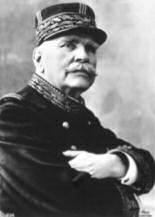
But early on an August morning of 1914, far below the same stone cows gazing across the bucolic panorama below, sat Maréchal Joffre observing the red-trousered French army battle the Germans who were on the march to Paris. Three hours later, satisfied the French soldiers were displaying adequate élan, Joffre had his chauffeur drive him to a station restaurant to enjoy "a good lunch."
Apportez-moi filet de boeuf saignant
pommes de terre frites
et une bouteille de Bordeaux. [9]
Envoi
the uniforms were woolen on that broiling day
the battle was lost by the French
the war continued four more years
Anita Virgil is a major American haiku poet since 1969. Her haiku, senryu, haibun, haiga, tanka and essays have appeared internationally in haiku magazines, haiku anthologies, textbooks and journals.
From 2004, most all her works appear online. Google: Anita Virgil.
[A Rare Moment : first published in Haibun Today, Vol 9 No 1, March 2015 ]
bibliography
The Guns of August by Barbara W. Tuchman
Quoted from Bantam Books, 1962, pbk, p. 420
an interesting video on Laon cathedral
(in French)
4:19 mins
Background
facts
Laon
approximate population
: 27,230
average altitude/elevation : 175 m
cathedral dimensions
total length : 110.5 m
nave width : 30 m
vault height : 24 m
north tower : 60.5 m
south tower : 56 m
end notes
Freely translated from La
cathedrale de Laon by Lucien Broche, 1926.
Vidame: Officer appointed by bishops
to handle their temporal interests, both judicial and
military, from which activities bishops were forbidden.
In due course, the appointment became hereditary and
sometimes the title transmuted in to viscompte.
Occurring mostly in the 11th and 12th centuries, by the 13th century, the post
was near defunct, as French kings curtailed their powers.
The vidame’s duties included managing and protecting
the estates of the bishopric, administering the episcopal
jurisdiction in the bishop’s name, to representing
the bishop different courts, leading the bishop’s
troops in battle.
Sanhedrin: ancient Jewish court
system, the Jewish ‘Supreme Court’.
Yoked medallions are two medallions
partially joined together.
Lancet: pointed, as seen in the
arches and windows with a pointed head introduced in
the Gothic period of architecture. [From the point of
a lance, or spear.]
A crozier is the large shepherd’s
stick carried by a bishop, or carried for him. The crozier
is generally very lavish, gilded in gold and topped
by an ornate hook. Shepherds use a long stick with a
big hook at one end to catch individual sheep. In christianism
there is a notion that the priest are like shepherds,
caring for their flock or in this case their congregation,
of which the crozier is the symbol.
In stained glass, a medallion
refers to circular or other shaped section of a window, generally one of many
within the overall window design, that contains a figure
or figures.
Image credits:
On left: Wikimedia Commons, Acroterion (Laon cathedrzl)
On right: 1900s postcard from abelard.org archives
Translation: "Bring me rare beef fillet,
fried potatoes
and a bottle of Bordeaux."