
|
Thus, the clerestory
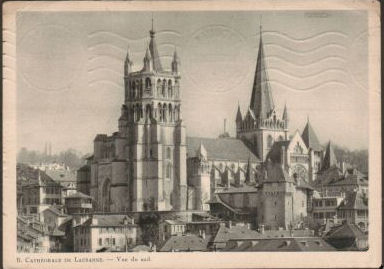
of Lausanne cathedral has clear similarities to the choir
at Canterbury, both following French Gothic design. The
style of cathedral is for the most part described as “primitive
Burgundian Gothic”. Regarded as the most beautiful
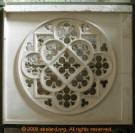
Gothic cathedral in Switzerland, this building has arguably one of the most impressive rose windows in the world. the most part described as “primitive
Burgundian Gothic”. Regarded as the most beautiful
Gothic cathedral in Switzerland, this building has arguably one of the most impressive rose windows in the world.
During the Middle Ages, the cathedral was a place of
pilgrimage , with about seventy thousand people visiting
each year. At this time, the population of the city of
Lausanne was only about seven thousand.
History
- 1170, construction started with an
ambulatory, using Roman materials. Most of the dressed
stone used in the cathedral is molasse.
1190, a second builder started the
present church; this took until
1215, Jean Cotereel, the third and
main architect, continued by constructing the western
- section, its porch and two towers, one with a belfry,
though the other tower was not completed.
- 1275, the cathedral was consecrated
by Pope Gregory X in the presence
- of King Rudolf of Habsburg
- 1536, during the Reformation, the
cathedral was stripped of almost all its
- decoration - altars, statues and paintings, leaving
the building’s interior remarkably uncluttered
and neat. The 12th century gold and silver Virgin and
child statue were melted down for coins, and liturgical
vestments and tapestries were put in a Bern museum.
Thus the Catholic cathedral came under Protestant control.
- 18th century, several restorations
works effectuated
- 1873, Eugène Viollet Le-Duc started
- restoring the cathedral, which restoration is still
on-going. Viollet-le-Duc died at Lausanne in 1879.
- 2007, the most recent restoration
of the exterior stonework, damaged by rain
- and other atmospheric pollution, was completed.
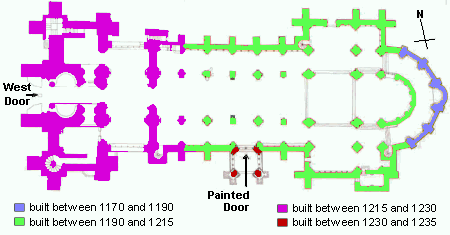
Cathedral
dimensions
- Length
- The cathedral: 80 metres/262 feet long
including choir: 20 metres/66 feet long
- Width
- Total aisle width: 26 metres/85 feet
including main nave: 19.3 metres/63 feet wide
- Height
- Nave arches: 32.5 metres/106.6 feet
Choir arches: 24.3 metres/79.7 feet.
Facade towers: 44 metres/144 feet
These are topped by an oak cross 4 metres/13 feet high.
- South rose window
- diameter: 8 metres/26 feet
stone tracery: 1205
glass: circa 1230
- Bell tower (Burgundy tower)
- A Burgundy oak frame supports 6 bells, the largest
weighing between 8,000 and 9,000 kg /17,600 and 19,800
pounds and measuring 2.07 metres/6.8 feet in diameter!
Stained
glass
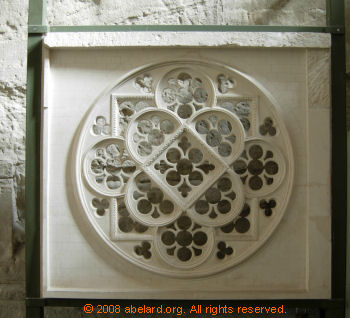
Maquette of the rose window’s
stone tracery
The
rose window [1231–35] in the south facade is
considered to be one of the most important roses in Europe,
together with those at Notre Dame in Paris and at Chartres.
The Lausanne South Rose was made by a wandering artist
from Picardy, Pierre d’Arras, and is related in
style and iconography to that of the Laon workshop.
In medieval times, large rose windows were often a representation
of the universe. Thus, Lausanne’s large rose contains
images representing the four seasons, four elements, four
winds, four rivers of paradise, as well as the twelve
labours of the months and the signs of the zodiac. [The
rose was restored in 1894-98 by E. Hosch. Missing panels
were replaced, while others, such as the centre, were
improvised.]
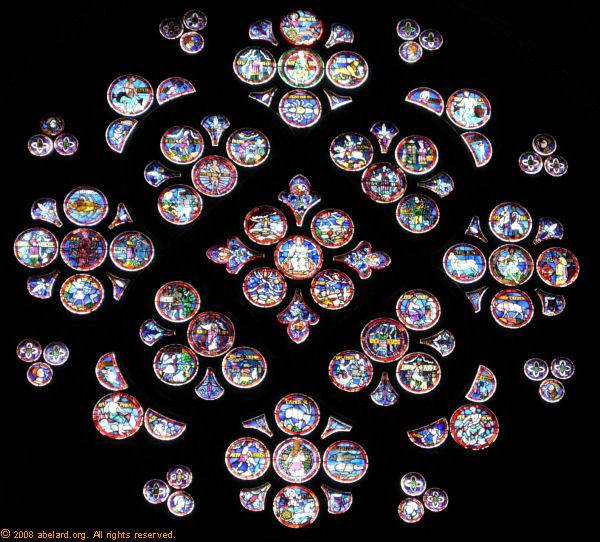
detailed
analysis of this rose
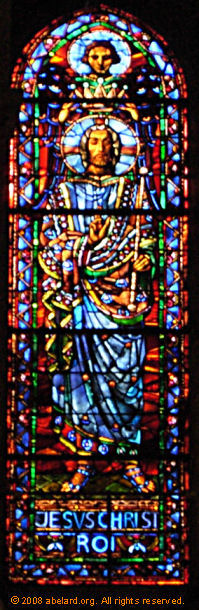
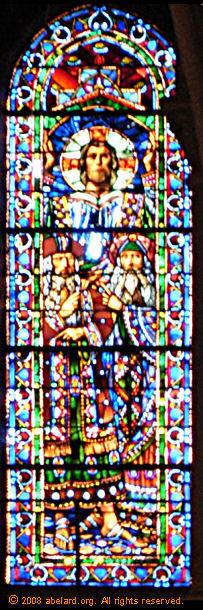
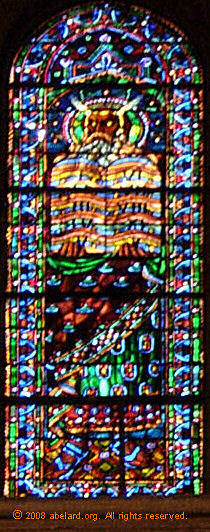
As well as the medieval rose, Lausanne cathedral also
holds twentieth-century glass that combines both medieval
and Art
Nouveau - Jugendstil - motifs. The glass was executed
during the inter-war years by French Swiss glass artists
Marcel Poncet, Louis Rivier and François de Ribaupierre,
Alexandre Cingria, Charles Clément and Edmond Bille.
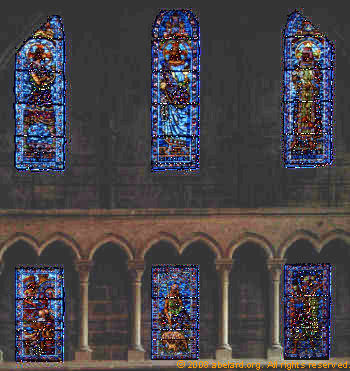
Taller twentieth century stained
glass above, shorter 13th century glass below
Twentieth-century stained
glass
The
organ
[Note central trumpet pipes ]
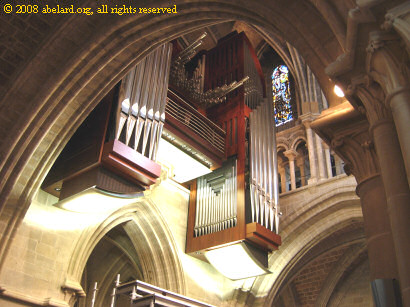
When the 1955 organ developed ‘breathing’
problems, the chosen builders, Massachusetts-based C.B.
Fisk, and Italian designer Giugiaro, made the new 7,000-pipe,
100-stop organ. Giugiaro, who designs Lamborghini and
other cars, modelled the body of the organ on an angel
floating floating on a cloud of light.
To see
in the cathedral
- Chapel of the Bourbon, south aisle:
- Front portals have medallions depicting the Creation,
the life of St. John, and the signs of the zodiac.
Stained glass in upper row of windows dates from 1501.
- Choir:
- 13th-century stalls. When the choir was refurnished
after the Revolution, these stalls were purchased from
the abbey at Cluny, which had put them on sale.
- High altar:
- Two crosses commemorating the union of the Greek and
Latin Churches - the Union of Lyons, proclaimed at the 14th
Ecumenical Council in 1274.
- South door - the Apostles’
or Painted Doorway:
- Medieval churches were known for their multicoloured
[polychrome] decoration of walls, doorways and statuary.
This remarkable example at Lausanne, reputedly one of
the best in Europe, was constructed between 1230 and
1235. Although it was not damaged by the destruction
of the Reformation, the painted statuary was covered
in whitewash. The portal was cleaned and restored between
1974 and 1991, and in 2007 when the statuary was consolidated
and high-tech glass panels were installed to protect
the porch.
The statuary of this portal includes:
Tympanum: the crowning of the Virgin and Christ in Majesty
in a mandala.
Lintel: Dormition and Assumption
of the Virgin.
Central pier: Archangel Gabriel and St-Michel.
Column statues, divided into four groups of three at
the four corners
near the doorway:
Moses, St-Jean-Baptiste and Simeon; and
St. Peter, St. Paul and St. John.
to the outside:
Isaiah, David, and Jeremiah; and St. Matthew,
St. Luke and St. Marc.
- South transept:
- Some medieval painting still extant.
- Entrance to sacristy, south transept:
- Fine 18th-century grillwork
Visitors can climb the 225 steps to the observation deck
of one of the two towers, overlooking the city of Lausanne
and with views across Lake Geneva. About half a million
people visit the Cathedral de Notre Dame every year.
Regular concerts are held in the cathedral to which the
general public is welcome.
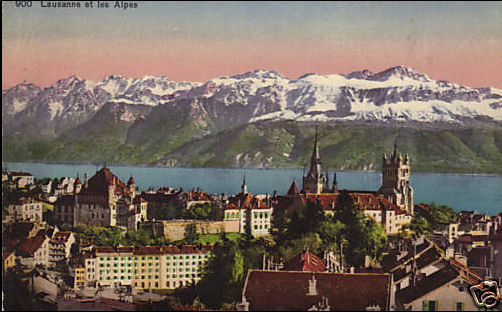
1924 postcard of Lausanne City, with
Cathedral de Notre Dame,
Lake Geneva and the Alps beyond
Lausanne Cathedral is now the only city in Europe to
follow a tradition started in 1405, of a night watch.
This was very important in earlier times, when most buildings
were made of wood, to prevent the all-too-common threat
of devastating fires. The watchman walks up to the top
of the tower, every hour on the hour from 22:000 to 02:00
(10pm to 2am). At the tower top, he calls out to the four
points of the compass: C‘est le guet; il a sonné
l’heure (“This is the night watch; the
hour has struck”). Since 2002, this task has been
performed by Renato Häusler.
Each year, on December 31 at midnight, to mark the transition
to the new year, a display of sounds, light and smoke
gives the impression that the tower caught fire.
Nowadays, Protestant services are held on Sundays at
10:00 and 20:00, the cathedral being closed to non-worshipping
visitors during these periods. From time to time, Catholic
services are held.
Opening
times and entrance charges
- April to September:
- Mon-Fri: 08:00-18:30/8am-6:30pm,
Sat: 08:30-18:00/8:30am-6pm
Sun: 14:00-19:00/2-7pm
- Oct-Mar:
- Mon-Fri 07:30-18:00/7:30am-6pm
Sat 08:30-17:00/8:30am-5pm
Sun 14:00-17:30/2-5:30pm.
- Entrance to cathedral: free
- to the tower: 2 F
| Background
facts |
Lausanne |
approximate population
: 125,885
average altitude/elevation : 528 m
- cathedral dimensions
- height of belfry : 67,50 m
height of lantern tower : 79,60 m (restored by Viollet-le-Duc)
|
end
notes
-
- Dormition:
- A major Christian festival is the commemoration
of the death of the Blessed Virgin Mary, called
in liturgical language the “Dormition of Our
Lady”. The Dormition is the first of the three
days that Mary lay before her ‘translation’
into heaven, on Assumption, 15th August.
|


 Le Mans and Bourges cathedrals - medieval space technology