|
|
|
|
|
|
|
|
|
|
|
|
|
|
|
places and playtime in les landes
|
|
||||
|
|
||||
new! Cathedrale Saint-Gatien at Tours
the perpendicular or English style of cathedral the fire at the cathedral of Notre-Dame de Paris Stone tracery in church and
cathedral construction stained glass and cathedrals in Normandy fortified churches, mostly in Les Landes cathedral labyrinths and mazes in France Germans in France on first arriving in France - driving
Transbordeur bridges in France and the world 2: focus on Portugalete, Chicago,
Rochefort-Martrou France’s western isles: Ile de Ré Ile de France, Paris: in the context of Abelard and of French cathedrals Marianne - a French national symbol, with French definitive stamps la Belle Epoque
Pic du Midi - observing stars clearly, A64 Futuroscope the French umbrella & Aurillac 50 years old:
Citroën DS the forest as seen by Francois Mauriac, and today bastide towns what a hair cut! m & french pop/rock
|
in les landesThe département of Les Landes in south-western France is a surreal, other-worldly place. Formerly nicknamed the French Sahara, Les Landes has been settled by friendly French people who take the fun part of living very seriously. Much of this ‘other world’ centres on the ever-present forest. Les Landes is a place of change. Once unsalubrious marshes and dunes, it was then covered by pine forest, much exploited for the resins as well as the timber. For a long time, well into the second half of the twentieth century, much of Les Landes, including the world of the forest, was poor. Now, today’s Les Landes has come into the modern world, developing a vibrant, mixed economy - from timber and timber products to its role as a major holiday destination, with empty countryside and extensive beaches, surf and seaside towns.
|
|||
The coast is being gradually colonised southwards from Bordeaux to Arcachon and on to towns like Mimizan, and northwards from Bayonne (the major port and town in coastal Pyrenees Atlantique), and even westwards from the larger towns inland, like Dax and Mont-de-Marsan (the department’s capital).
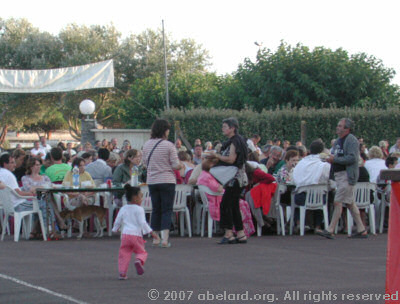
During the twentieth century, other seaside towns have developed to become similar to the British holiday camp phenomenon of, for instance Butlin’s, during the summer season.There are tens of thousands of visitors, both French and foreign, who come for a seaside vacation, complete with entertainments, including bands and dances in the town square, organised by the town council, local commerce and various associations. Mimizan, Contis, Lit-et-Mixe, Veille-St. Girons, Léon, Moliets, Messanges, Vieux Boucau, Soustons Plage, le Penon, Hossegor and Capbreton are amongst the seaside resorts that offer sand and sea to go with the summer sun. The 38 zones of supervised swimming (see just below) are cleaned at least every three days. safety warning for sea swimming As part of the draining of the marshes of the moors, lakes were made, often called Étangs. Some of these, such as the one at Vieux Boucau, are recreational lakes with swimming, wind-surfing, fishing and paddle boats; while others are nature reserves with herons, tortoises and tranquility. (These we will not name, to ensure that they are not swamped with visitors, look at maps and seek them out yourselves!) |
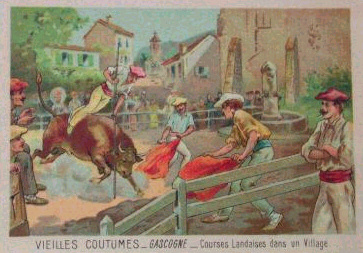
In the Course Landaise, both the animals and the human participants, the toreros, are awarded points for their prowess in their particular roles. The goal is for the écarteurs [swervers] and the sauteurs [jumpers] to provoke a semi-wild small cow, the coursière, to charge and, at the last, moment to avoid being gored by either swerving away from the animal, or by jumping over it, often in spectacular fashion.
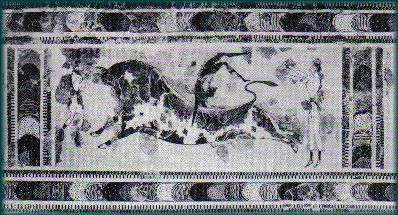
a short history of the Course LandaiseThe Course Landaise certainly has many similarities to the sport of jumping over bulls practised in ancient Crete. However, it looks probable that the men of Les Landes came to their sport from a different route.
|
end notes
|
| abstracts | briefings | information | headlines | loud music & hearing damage | children & television violence | what is memory, and intelligence? | about abelard |
© abelard, 2007,14 april the address for this document is https://www.abelard.org/france/department_les_landes_playtime.php 3280 words |








 About
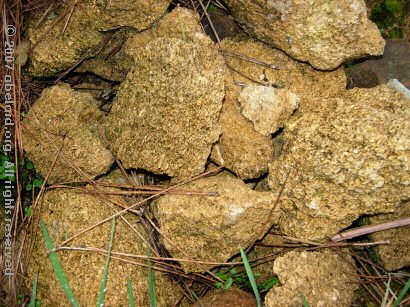
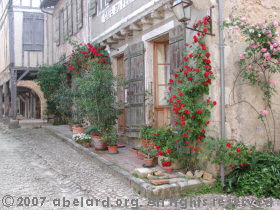
3 kilometres from the Armagnac Museum is one of the best preserved
About
3 kilometres from the Armagnac Museum is one of the best preserved 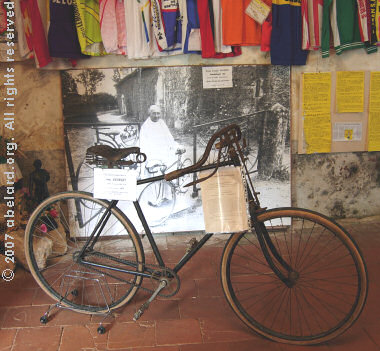
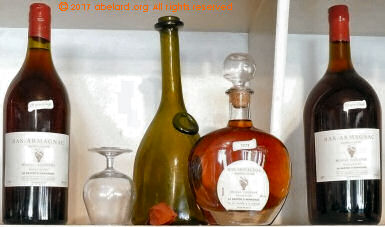
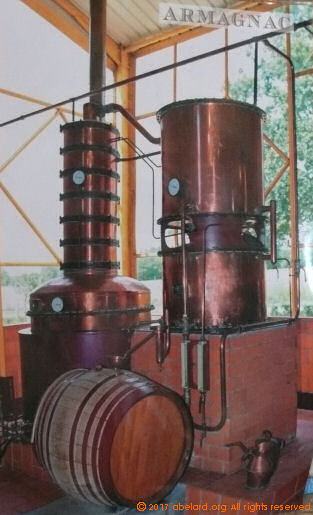 which
was first made by the Celts.
which
was first made by the Celts. 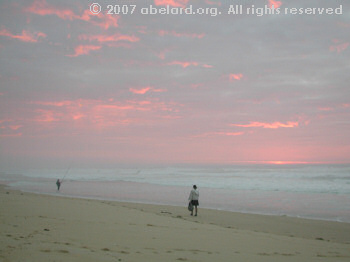 Les
Landes is graced with La Côte d’Argent
- the Silver Coast, 100 miles of white, sandy beach
looking west onto the vast expanse of the Atlantic
Ocean. The Silver Coast was so named from 1905, when
Maurice Martin, a Bordeaux journalist, wrote of the
Landais coast:
Les
Landes is graced with La Côte d’Argent
- the Silver Coast, 100 miles of white, sandy beach
looking west onto the vast expanse of the Atlantic
Ocean. The Silver Coast was so named from 1905, when
Maurice Martin, a Bordeaux journalist, wrote of the
Landais coast: 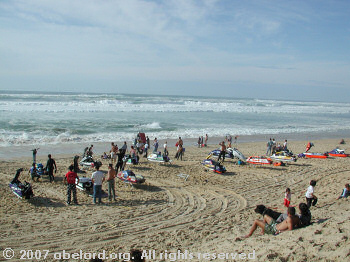 One
of the first seaside resort towns to appear was Hossegor.
This increasingly cosmopolitan town is now the Landais
capital of surfing, and headquarters of surf clothing
manufacturers and international surfng competitions.
Hossegor is both on the coast and on a salt-water lake.
The local environment, being sheltered, has a balmy
climate that suits the masses of sweet-scented mimosa
trees that bloom in February and March.
One
of the first seaside resort towns to appear was Hossegor.
This increasingly cosmopolitan town is now the Landais
capital of surfing, and headquarters of surf clothing
manufacturers and international surfng competitions.
Hossegor is both on the coast and on a salt-water lake.
The local environment, being sheltered, has a balmy
climate that suits the masses of sweet-scented mimosa
trees that bloom in February and March.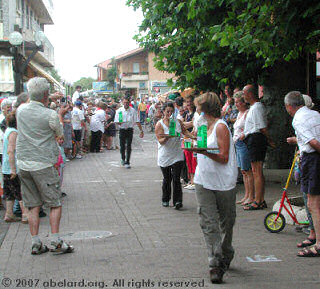
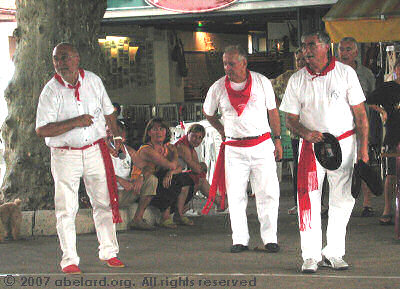
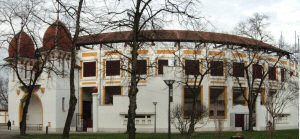 Almost
every medium and large town in the southern parts of Les Landes
has an arène, an arena used primarily for entertainments
and sports with cows or bulls, though also used to hold other
events such as folk dance and music displays. [
Almost
every medium and large town in the southern parts of Les Landes
has an arène, an arena used primarily for entertainments
and sports with cows or bulls, though also used to hold other
events such as folk dance and music displays. [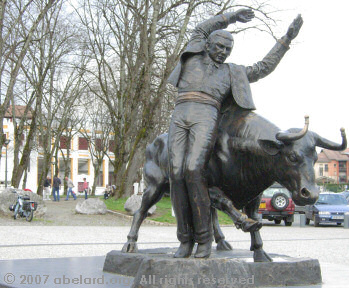 But
in Les Landes, although there are some week-long corridas [bullfights] of red-blooded (and bloody) bull-fighting, there
is also the much more civilised (to our minds) sport - the Course
Landaise. Mind you, sometimes you can find a corrida portugaise [Portugeuse bullfight] where the animals are not killed, at least
not in public view.
But
in Les Landes, although there are some week-long corridas [bullfights] of red-blooded (and bloody) bull-fighting, there
is also the much more civilised (to our minds) sport - the Course
Landaise. Mind you, sometimes you can find a corrida portugaise [Portugeuse bullfight] where the animals are not killed, at least
not in public view.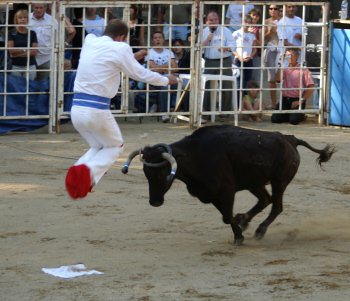
 During
the 19th century, there were two events that changed the Course
Landaise to become the sport of today. Firstly, came the regulation
that the Courses only be held in enclosed, terraced arenas. From
this limitation of space was born, first the swerve and then the
jump, the two main artistic and athletic moves.
During
the 19th century, there were two events that changed the Course
Landaise to become the sport of today. Firstly, came the regulation
that the Courses only be held in enclosed, terraced arenas. From
this limitation of space was born, first the swerve and then the
jump, the two main artistic and athletic moves.