|
|
|
|
|
|
|
|
|
|
|
|
|
|
 |
|||
|
|
||
new! Cathedrale Saint-Gatien at Tours
the perpendicular or English style of cathedral the fire at the cathedral of Notre-Dame de Paris Stone tracery in church and
cathedral construction stained glass and cathedrals in Normandy fortified churches, mostly in Les Landes cathedral labyrinths and mazes in France Germans in France on first arriving in France - driving
Transbordeur bridges in France and the world 2: focus on Portugalete, Chicago,
Rochefort-Martrou France’s western isles: Ile de Ré Ile de France, Paris: in the context of Abelard and of French cathedrals Marianne - a French national symbol, with French definitive stamps la Belle Epoque
Pic du Midi - observing stars clearly, A64 Futuroscope the French umbrella & Aurillac 50 years old:
Citroën DS the forest as seen by Francois Mauriac, and today bastide towns what a hair cut! m & french pop/rock
|
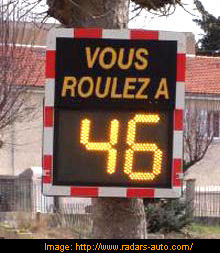
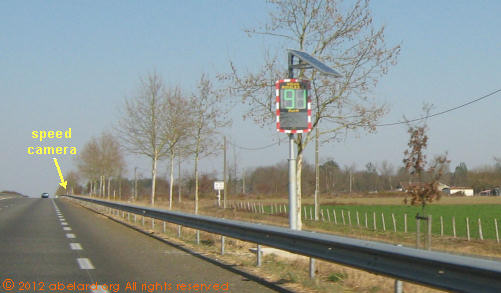
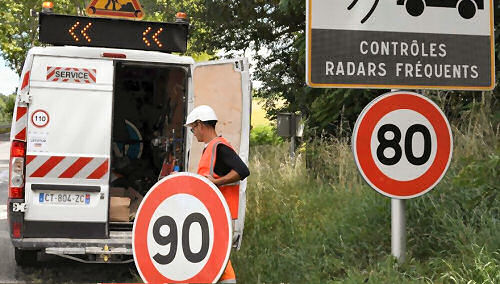
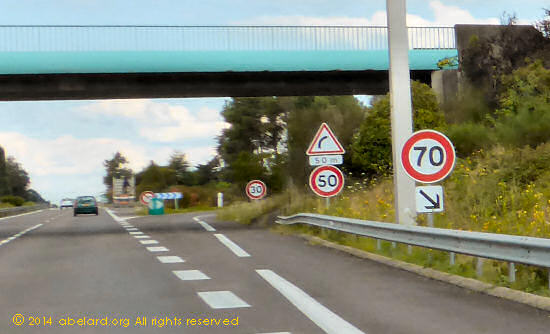
You land driving in France from the ferry or train. You are very likely to be on motorways sfor a good while as your first experience. Prepare! Think ahead. Food is probably better in the supermarkets than anything you bring with you. Depending when you land, if you do not like giving money away to shysters, then have enough fuel to allow you to reach where you intend to first shop. The Channel ports all have supermarkets, but the northern retail centres [centres commerciaux] are usually somewhat seedy: OK for that quick dash across for the duty free, alright for a stop if you can afford the time and do not mind the hassle. Or you can plan ahead, carrying enough fuel to arrive at your first option further down the motorway, at a supermarket just outside a town next to the motorway. For road fuel prices in France. So to finding that vital, elusive supermarket stocked with cheaper fuel and decent food. You need to know the names of several of the main chains: Carrefour, LeClerc, Geant or Casino, Auchan, Super U, Intermarché, Champion; then look for their road signs. Almost every substantial town has a ring road, or rocade, often despoiled by vast human beehives for the poorer classes [habitations à loyer modéré or HLMs - modest rent housing], but enlivened with hoardings and large retail complexes There, the various huge stores live often alongside cafés, do-it-yourself [bricolage], garden centres [jardinier], many smaller shops and, of course, the cut-price service station. french signpostingThe French idea of signposting is rather slapdash and idiosyncratic, 5mn gauche [5 minutes left] or droit [right]. Well, it sort of depends on your speed, doesn't it, and do they mean on this road or turn right? Expect some navigational messing around 'til you locate the gold mine, not to mention ever-impatient drivers as you dither. Another favourite game is that when you want to turn left (across the oncoming traffic), you first have to turn right and then double back. Good hunting. Eventually you find the supermarket, not much different from the English chains, except often a great deal larger [called hypermarchés or grand surfaces] and with much wider range of goodies. They are somewhat cheaper than Britain, especially when the pound is relatively strong. As of late 2014, it is the euro that is still overvalued. Another wonder of French signposting concerns speed. The French government, helped by speed cameras, is now fining drivers left, right and everywhere to reduce fatal road accidents and, of course, make more money. Despite this, departmental and communal administrations prefer trying to instruct drivers to drive more slowly by signing. Here is one example seen on a road with a 110 kph speed limit.
As you can see, by the relative sizes of the discs, these signs are well within 100 metres of the exit from the main road. I’m surprised that they haven’t put a radar trap here. driving aroundFinding your way around towns often is not simple.[5] You will often find yourself driving around in circles, trying to garner directions from them forriners who usually do not speak English too well. Of course, all the roads are the wrong way around, yu're driving on the right!, the road signs ain’t great,[6] and the French cannot drive. No, they seriously cannot. France has twice the area of the whole UK to spread out about the same population, but until recently they still managed to kill twice as many people. The moment my wheels touch France, I drop my speed a full 10-15 mph. No, I’m not kidding! The French are not just dangerous drivers, they are widely and generally incompetent drivers. It is for this reason, and associated with the French problem of turning across oncoming traffic (that is trurning left), there are more and more rond-points (roundabouts) and systèmes giratoires (multiple, connecting roundabouts, bridges and underpasses). Large numbers of French towns are very cramped , which can make parking a major problem, especially if you do not know your way around. Most French people drive around in tiny, little prams and the parking spaces are widely designed to accommodate that sort of vehicle. If you are going to hire a car and expect to spend a lot of time in towns, you should consider the possibility of booking a small hire car. priority from the rightBy the way, the bizarre priority from the right rule still exists in France, a piece of Gallic logic created supposedly to regulate who goes first when two or more roads meet, except those which have the sign below, the driver emerging from the rightmost road at an intersection has the priority to go cross that intersection first, or even to turn onto another road. So, you may find a driver stops on a larger road to allow a car waiting on a side road (to the right of the main road) to turn onto the larger road. [7] Also, French cars will surprise you by jumping out of side roads and onto roundabouts ahead of you, on the basis of having priority from the right [priorité à droite].
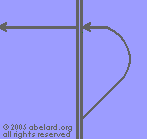
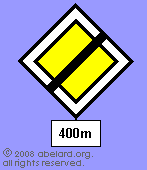
You should learn to recognise this sign. On roads with this sign, drivers have priority to when going across intersections or turning onto another road. There is also a version with a line through it, meaning “this road does not have priority”, that is cars coming from the right onto this road have the priority.
You are no longer are
on a road with priority; Roundabouts are generally exempt from this rule (cars should not just drive out onto the roundabout on the basis that they are to the right of cars already going round, although often they do) - note the cedez le passage/give way signs. These mad priority signs, a positive clear sign telling you that idiots cannot jump out from your right and a negative sign (that has a cancelling line across) telling you that other drivers may jump out ahead of you, appear to have been developed by French bureaucrats attempting to correct the mess they had made previously with the generalised priority from the right rule. Even today, I have had a driver stop on a main road to let me out of a side road, with the usual screeching of brakes as others try to stop behind him; while still a considerable percentage regularly jump out onto roundabouts against oncoming traffic. Doubtless, the powers cannot admit to making this incredible foul-up, so I return you to my original advice: drop your speed in France and recognise that the French just cannot drive - assuming you want to live.
The priorité à droite rule, known in English as ‘the nearside rule’, was adopted by the Paris International Automobile Convention in 1926, then confirmed in Geneva in 1949 and in Vienna in 1968. The priorité à droite rule started in Paris, instigated in 1910 by a Prefect of police, M. Lépine. Prior to this, the rules of priority on the road were very complicated, right of way being given according to the social rank of each passenger. Thus, it is said that passengers had to get off a coach to compare their titles and so decide who would pass first, according to the degrees of nobility! |
|
|||||||||||||||||||||||||||||||||||||||||||||||||||||||||||||||||||||||||||||||||||||||||||||||||||||||||||||||||||||||||||||
other driving ‘delights’The Italians are mad, but good, drivers; the French are generally just stupid. The Spanish live somewhere in between! There is none of the habitual lane discipline you see in Britain; straying across the white lines is optional. As you are driving on the ‘other side’ of the road, you may well have an instinct to go the other way around a roundabout, or pull across to the now unfashionable side of the road. If you are unaccustomed to driving a continental, left-hand drive vehicle, you will have a great deal more to cope with on top of that. So, if you wanna live, drop your speed and drive much more defensively than most sane people drive, even than in Britain.
|
|||||||||||||||||||||||||||||||||||||||||||||||||||||||||||||||||||||||||||||||||||||||||||||||||||||||||||||||||||||||||||||||
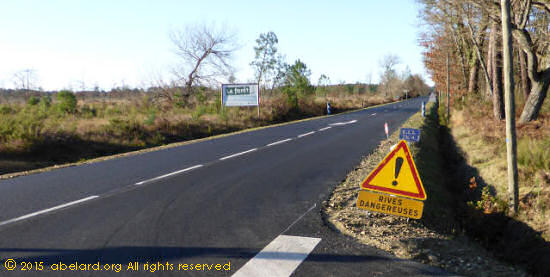
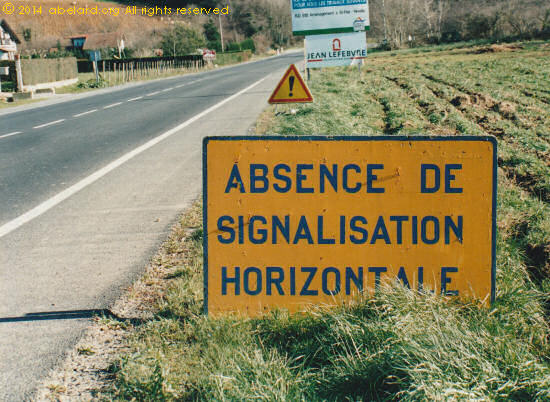
Verges and deep ditches in shadow on a newly re-tarmacked main road. At the moment, there is one temporary
sign warning of dangerous banks, but this danger continues right into the distance. |
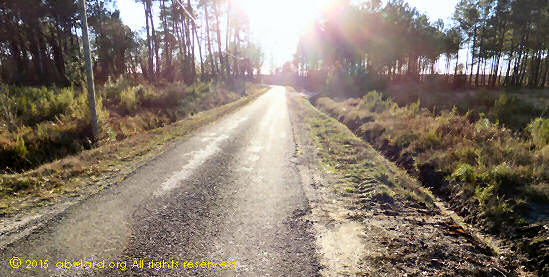
Ill-defined verges along a country side road, where the verges slope down to the ditches. The tyre marks
of lorries can be seen in the muddy verge, as can the tarmac starting to break up on the border of road and verge as vehicles manoeuvre
to pass one another. |
No, I’m not joking. Drop your speed at least 10 mph, and live longer.
In France, you pay through the nose for most motorways [autoroutes] (there are a few free motorways, around large cities and in Northern France) but there is one great joy and luxury that comes with this cost – an immense variety of aires. Read more about the autoroute network and the more interesting aires in motorway aires, introduction, also accessible from the drop-down menu at the top of this page.
Answer to a frequently asked question
The distance from Bordeaux to the Spanish border is about
120 miles/200 km.
You drive on the A63.
Our section on fuel prices in France, and other current information concerning them is now housed on its own page. with sections on road fuel prices in france and archived articles on road fuel prices.
Also see pre-route planning with GoogleMaps.
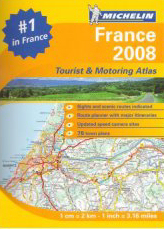 Use
a large road atlas, such as the one published
by Michelin, for your preliminary trip planning.
Once you have determined the general route, then
use on-line planners which
can give detailed information on distances, toll
and fuel costs, and the location of speed cameras.
Use
a large road atlas, such as the one published
by Michelin, for your preliminary trip planning.
Once you have determined the general route, then
use on-line planners which
can give detailed information on distances, toll
and fuel costs, and the location of speed cameras.
For more local maps, use Institut Geographique National (IGN) Blue Series maps. IGN is the French equivalent of the Ordinance Survey in the United Kingdom. Blue Series maps are 1:25,000 or 1 cm to 250 metres. The maps can be bought in a local Presse/newspaper shop or supermarket. However, this is a little haphazard, especially for the high-scale versions, as these places usually only hold maps local to them.
Mappy is an excellent, if slightly clumsy, on-line road planner. It also gives you the option of checking your toll costs for using motorways.

Map24 is another online route-planning site, with several Java-powered interactive facilities. Although in French for the map of France, Map24 is mostly intuitive to use and can even be fun. It is possible to look at the map related to your chosen itinerary in various degrees of three dimensions [VUE 3-D], as if low-flying over the land. The amount of zoom can (almost too) easily be changed [ZOOM]; while when at least one intermediate way-point is specified, you can select which part of the journey to study [NAVIGATION].
Remember to prepare your car to be both legal and safe in France.
| Advance warning | |||||||||||||||||||||||||||||||||||
update 11.10.18 Level crossings can be trickier than you think - another cash cowNot only does a driver have to make sure their car does not stall, or a cyclist that their wheels don't get stuck, there is a further traffic trap to be found at some level crossings (passage à niveau). In 2017, there were 15,405 level crossings on the national railway network - 0.4% were across national roads, 31.4% across departmental roads and 68.2% across municipal roads. Bearing these numbers in mind, there is a grand total of 80 level crossing cameras in France, that is one for every 192 crossings. A rare creature then, that is installed on what is called "priority crossings". The camera is very similar to those used with traffic (red) lights. The essential difference is the level crossing red flashing lights are synced to alternate with the camera flashes so each snapshot can highlight when the signal turned on. There is a safety delay, after which drivers who go across the crossing are flashed and fined (90€, and 4 points deducted for three years for holders of a French driving licence). The first flash occurs when a vehicle starts to cross the line, |
|||||||||||||||||||||||||||||||||||
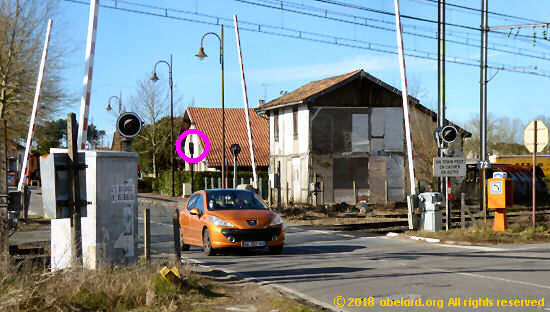 View showing a railway level crossing camera (circled in pink) |
|||||||||||||||||||||||||||||||||||
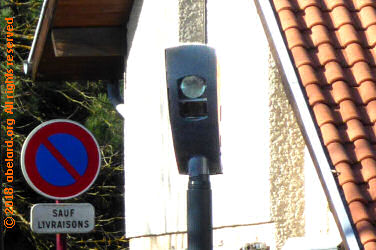 Railway crossing camera - close-up |
|||||||||||||||||||||||||||||||||||
safety delay and reaction timesIn order to allow users to stop safely to comply with the flashing signalling, there is a safety delay, similar to the amber light for traffic lights, is set on the equipment. This delay is 3 seconds in built-up areas and 5 seconds outside built-up areas. It is only after this time that illegal crossings will trigger the radar flash. Note that for an average driver, from reacting to starting braking is 2.3 seconds. Some drivers take three seconds even to react, while a common reaction time of 1.5 seconds is often used in accident reconstructions. At least that time again is needed for the car to stop under braking. When driving at 50 kph (the maximum legal speed in towns), the reaction distance is just over 7.7 m or two car lengths, while the braking distance is over 15 m or four car lengths, the total average stopping distance being 23 m or 6 car lengths. This is not good when you are being followed by the typical French tailgater. Clearly, someone is more interested in money than common sense. update 13.09.15 Front and back-flashing cameras From Monday 14th September 2015, a new generation of speed cameras is coming into full service, with fines being issued to vehicles flashed.
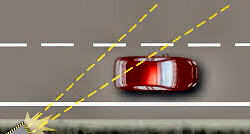
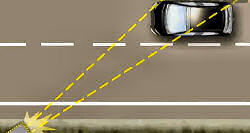
The new cameras photograph both front and rear number plates. One version of the cameras photographs one car two times - as it approaches the camera and then again as it goes past and away (there is little further information available on these cameras). In the other option, the cameras photo the number plates of approaching cars in one lane, as well as those of cars going away on the further lane of a two-lane road.
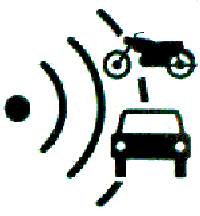
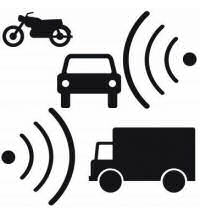
Regarding the first type of two-direction camera, the justification for photographing a car's registration twice is that 38% of photographs are legible, so this will double the chances of having a usable photo. It also means that the authorities can have a photo of the driver's face, which could help in cases when the car's legal owner was not the offending driver. For the cameras that will photo cars on either lane of a two-lane road, it doubles the number of possible finable victims. These cameras can only be mounted at one side of a road, at ground level. They do not function on gantries, nor in the centre of a dual carriageway road or motorway, not on a pole (like traffic light camera installations). Kindly, "information panels are systematically installed" in each direction on the roads controlled by such equipment. And they are different to the current
To begin with, the new two-direction cameras will be operating in 20 departments:
In all, 111 cameras will being put into service now. This will increase to 200 by the end of 2015, and a further 500 is expected in 2016. Many of the cameras are existing cameras that are having their software up-graded. As a result, the cost of the new system is reported to be 'only' 15,000 €. france's speed camera cash cowThese cameras are being introduced now because the number of deaths on the roads is increasing again. However, only a quarter of fatal road accidents are caused by "excess speed", so these cameras appear to be more jackpot-paying slot machines (machines à sous) than accident-prevention devices. A French driving magazine has done some research, and found that 52% of speed cameras are not put in accident-prone zones. Why? Well, they do not make as much money. Cameras in accident-prone zones only flash 4,774 times in a year, while those in non-accident prone zones flash 12,000 times. There are over 9 million automatic road cameras operating in France. When a vehicle is flashed, the traffic control computer systems have to co-ordinate with other data systems holding driver's and vehicle details in order to be able to fine and deduct points. According to a government report, 46% of offenders have no points deducted. If a person is driving a company car, the company most often pays the fine. There is a 12% likelihood that later the driver will be billed. Lastly, a good percentage of cases fail for 'technical' reasons. Mind you, it's still a good thing to drive at a moderate speed, both for your nerves and for helping to minimise carbon dioxide emissions! update 09.04.12 From today, all radar alerters and GPS systems, like TomTom, that can alert the user to an approaching speed camera, must have been updated to indicate “Danger Zones”, rather than individual cameras. The fine for using such a machine that has not been updated is 1,500 € and the loss of 6 points from your driving licence. A “Danger Zone”, and its warning on alerters and GPS, may start 2 kilometres before there is any camera. Their length may be 300 metres, 2 km, or 4 km. The ‘danger zones’ may be
Until your GPS is up to date, disable the radar camera detection facility. Then you can update your GPS software later. If you are stopped by the police or gendarmes, you must be able to present a certificate that you machine has been updated, otherwise it will be considered to be a radar detector and you will be liable to that 1,500 € fine and 6-point removal.
update 23.05.11
May 2011 It is being announced in French newspapers, by September 2011, many new rules proposed to penalise bad drivers. These new strictures, no doubt, would help Nicholas Sarkozy in the run up to the next Presidential election in 2012, while much increased fines would help the French Treasury, which like so many others is suffering in the current financial malaise. A greater constraint on speeding will also control fuel consumption.
And don’t forget that wearing a fluorescent waistcoat is now mandatory if you are on the roadside outside your car. |
|||||||||||||||||||||||||||||||||||
During 2006, the frequent contradictory, badly placed road signs have even come to the notice of the French TV news and the government. Now it is official, you can expect to see consecutively speed signs of 70kph, 90kph, 50kph within a few hundred metres/yards of each other.
In contrast, French speed cameras are well forewarned
-
all changed, see
above.
Although we had been informed that the large prominent signs (below) would be removed progressively, this did not happen, so drivers should still keep a look out on seeing such a sign.
Although the location of each speed camera is no longer
identified by the French government on their web sites/maps, information can be. If you
generate an itinerary using Mappy,
it will locate (approximately) where there are any speed
cameras on your route.
Also, various motorist groups do provide them, usually by region. Here is one such fixed radar/camera web site, which is being kept up to date. [For other similar pages, try searching on “radar routes france carte”]
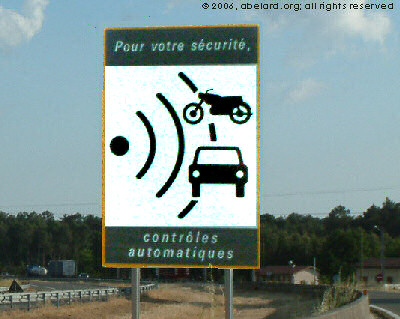
French road sign warning of a speed
camera ahead, now being withdrawn
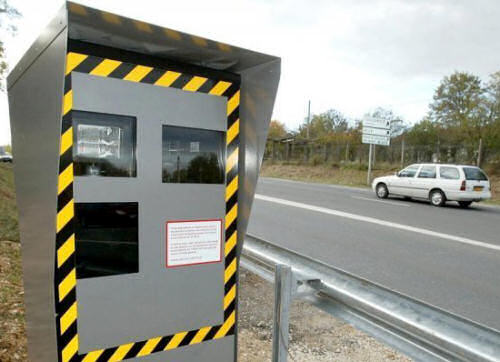
However, although the warning sign is prominent, the camera that follows is often placed discretely - under a bridge, behind a road barrier, near a roadside planting. Also be aware that French fixed cameras are not set on high supports as in the UK, but are attached to a short support near the ground. There is no reason in France to receive a speeding ticket from a fixed camera, the signs like that photographed above are very prominent and usually several hundred yards before the camera - see a sign and make damn sure your speed is comfortably below the local speed limit. You can even take pleasure in watching the cars rushing past who are then flashed by the camera.
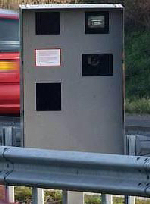
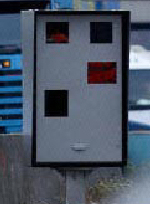
French fixed radar speed cameras
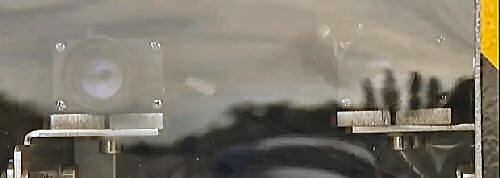
left: photographs front
of vehicle; right:
photographs rear of vehicle
As well as the 1,000 fixed cameras on French roads, installed since October 2003, there are also many mobile cameras used by gendarmes. These may be set up at the roadside, or looking out from the back of a police estate car. These cameras should also be signed by a smaller, mobile warning sign. Remember les flics are out to meet targets and to make money. Therefore, they may ‘forget’ to put out the sign.
French speed cameras send two photos and accompanying data to a central processing point that, after assessment that the driver was speeding, automatically sends out the paperwork demanding the fine.
Fines are on sliding scales, depending how much above the local speed limit the car was going. Be aware also, that the fines are accompanied by a deduction of one or more points from the driving licence, again on a sliding scale.
If you receive such a demand, it has to be paid first (with the amount doubling if there is delay) and any dispute can be made later.
However, as a foreign visitor, you may well escape paying a fine, unless you are caught by a roadside gendarme who demands an immediate fine, or unless your car is registered in another European Union country that has a bilateral agreement.
Euroland is gradually moving to reciprocal recognition and shared data record storage of car registration. The first countries that are moving towards such arrangements are Germany, Holland, Spain. This situation will be complete when the proposed European driving licence is in place.
April 2010: Permission has been given for a further 3,000 surveillance cameras to be installed in towns. The French police are using them to watch for ‘bad’ actions by drivers, in particular stopping or parking in illegal locations. As towns become more crowded with traffic and parking is often reduced to provide more pedestrianised areas, finding somewhere to stop is becoming more irksome. Note that fines can be 2000€ or more.
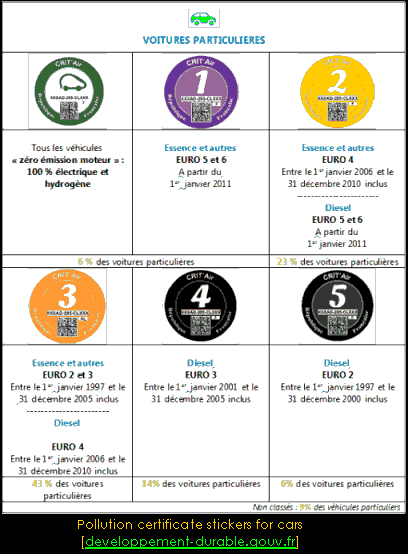 From the beginning of 2017, a new requirement rolled out to reduce air pollution caused by cars - the older ones and, particularly, those with diesel engines. Drivers must display Crit'Air stickers to show how much the car pollutes, the different colours on the stickers indicating the level of pollution (the most polluting cars have no sticker). Although this requirement has been voluntary, Crit'Air stickers are now mandatory in 12 cities with considerable pollution problems. The cities include
There are also Restricted Areas (ZCRs) that include
Annecy, Chambery, Arve Valley, Côte d'Or/Dijon, Cruqe/Guéret, Deux Sèvres/Niort,
Drôme/Valence, Eure-et-Loire/Chartres, Gers/Auch, Haut-Savoie/Annecy, Isère/Grenoble, Loiret/Orléans, Maine-et-Loire, Puy-de-Dome/Clermont-Ferrand, Pyrénées-Atlantiques, Rennes, Savoie/Chambery, Vendée/La Rouche-sur-Yon, Vienne/Poitiers.
These zones can be activated temporarily as necessary, depending on the air pollution levels.
Air pollution, in particular from fine particulates and nitrogen oxide, is blamed for 2,500 deaths a year in Paris and 5,500 across France, higher numbers are also quoted.
The Crit'Air stickers, costing 3.11€ plus postage (total: 3.72€) are available from a government website (language selection at yop right of the page).
The application is spread over several pages, requiring full details of the vehicle's registration and a copy of the up-to-date registration certificate. The certificate has to be uploaded as a .pdf, .png or .jpeg format file, less than 400kB in size.
Note that after ordering, the sticker can take 6 weeks to arrive in the UK. However, French officials say that showing a printed copy of the email confirming the purchase of a sticker will be sufficient to show to police if the car is stopped.
The different categories are divided into petrol [essence] and diesel cars, and then when the car was first immatriculated (given an number plate).
Fines start at 68€ for light passenger vehicles, witht the fine increasing to 135€ if not paid within 45 days. Remember that you can and will be chased for payment in the UK.
Paris
"Paris is entering a new phase in its pollution control plan: from 15 January 2017, it will become the first Restricted Area (ZCR) in France. Vehicles circulating in Paris must be equipped with an air quality certificate, "Crit'Air", established by the Ministry of Ecology and Sustainable Development, that is to say a sticker indicating their Level of pollution.
—
"All vehicles are concerned without exception including those of disabled people and foreign vehicles."
All cars, vans, motorbikes and lorries entering Paris proper, the periphérique (the major ring road around Paris) and the Bois not being concerned, between 8.00 and 20.00 Monday to Friday, must have a Crit'Air sticker. If not, the driver is liable to be fined up to €68 for cars and €135 for lorries. There is no exception for foreign cars, even if just passing through Paris on the way to somewhere else.
This in addition to lorries, coaches and buses registered before1st October 2001, petrol and diesel cars registered before 31st December 1996, and motor bikes and similarly engined vehicles registered before 31st May 2000 being banned all together.
As of 1 July 2017, the traffic ban will apply to diesel and light commercial vehicles with a Euro 2 sticker (put into service before 1 January 2001 - no new prohibition for petrol vehicles before that date) and heavy goods vehicles Euros 3 sticker (registered before 1 October 2006).
Make sure that your car is in a good state when you come to France; From May 2018, the French M.O.T. is becoming much more strict as the result of an EUSSR edict. Although, foreign cars do not have to submit to a French M.O.T., gendarmes can be expected, when stopping foreign cars, to take advantage of the new regulations to help reach their targets for collecting fines.
| Distance | Fuel cost | Tolls |
| Current examples: | ||
| 275 miles | 44€ | 28.40€ |
| 122 miles | 20€ | 16.60€ |
| [Based on supermarket diesel prices
during May 2008, and average fuel consumption of 9 miles/litre, approx. 41 miles/UK gal.] |
||
| Conversion table | imperial [UK] gallon | US gallon | litre |
imperial (UK) gallon |
1 | 1.2 | 4.546 |
| US gallon | 0.83 | 1 | 3.785 |
| litre | 0.22 | 0.26 | 1 |
| Evolution of diesel
[gazole] prices at supermarkets in France since 2001 |
|||
| Jul. 2001 | 0.755€/l | Jul. 2005 | 1.02€/l |
| Jan. 2002 | 0.70€/l | Jan. 2006 | 0.999€/l |
| Jul. 2002 | 0.739€/l | Jul. 2006 | 1.09€/l |
| Jan 2003 | .0789€/l | Jan. 2007 | 1.00€/l |
Jul. 2003 |
0.72€/l | Jul. 2007 | 1.058€/l |
| Jan. 2004 | 0.78€/l | Jan. 2008 | 1.17€/l |
| Jul. 2004 | 0.84€/l | early May 2008 | 1.295€/l |
| Jan. 2005 | 0.87€/l | late May 2008 | 1.428€/l |
| Apr. 2010 | 1.136€ | Aug.2011 | 1.274 € |
Buying fuel from supermarkets is approximately 15-20% cheaper than on the motorways.[1] You will save, perhaps, the equivalent of up to 1p per mile if you use supermarket petrol, and with diesel you can save most of 3p per mile compared to the UK [prices during July 2004].[2]
But if you drive on the tolled motorways, the tolls
will cost you approximately 8p a mile[3] (about the same as the fuel cost).
There are two types of kit: the expensive [100 € or more], electronic kit which is reusable; and the cheap [1 to 3 €], throwaway, chemical kit. In France, one of the places to buy these is in the local pharmacy.
Cars and other vehicles with two or more wheels (mopeds, 50cc or less, are excluded) will be checked before they even hit French roads, with random checks in the Channel Tunnel and on cross-channel ferries.
Since 2006, drink-driving has been the greatest cause of the over 4,000 road deaths a year, greater even than those caused by speeding. Drink resulted in nearly a third of road deaths, a number "virtually unchanged for 10 years" and "far superior" to England (17%) or Germany (10%), with similar levels of alcohol consumption.
Leclerc supermarkets will sell its fuel at cost price during the next seven weekends of the summer. From June 30 to August 13, 696 of the brand's service stations will not make any mark-up on fuel. “Our competitors are going to have to be trained and I hope we will energise the market,” says Michel-Édouard Leclerc told Franceinfo. However, the savings made should not be very high for motorists, since the margins are already very thin since the period of fuel price inflation.
Thus, until the end of August, take advantage of "prix coutant" weekends to fill at a Leclerc supermarket.
In the meantime, the price of a barrel at its lowest for a year and a half while prices at the pump hardly move. The opinion of a French driver, "Wholesalers and resellers fill their pockets by emptying ours."
At the start of 2022, fuel prices at the pump are reaching new heights. This increase is expected to continue in the coming months.
For the past year, the rise in fuel prices has been dizzying : the price of diesel has increased by 31.2 cents, that of unleaded 95 by 28.8 centimes, and that of unleaded 98 of 29.5 centimes.
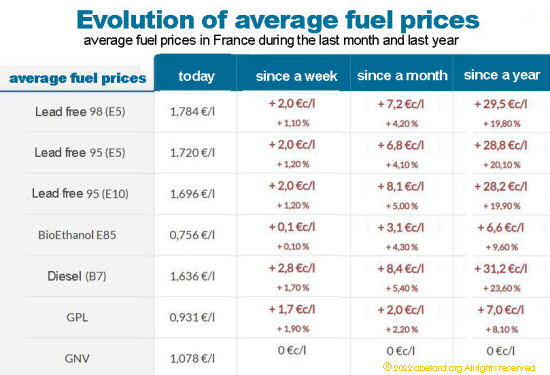
source : carbu.com
This exceptional rise in fuel prices is not unrelated to the health crisis. "Despite the rise in Omicron cases, European governments believe the time has come for an easing of restrictions, fueling hopes of a rise in oil demand," said analyst Tamas Varga, quoted by Reuters. Generalised confinements,with the consequent freezing of the economy, are no longer envisaged.
The price surge is also explained by the current tensions in Kazakhstan. These are pushing up oil prices to a degree, as investors fear future supply disruptions from the largest oil producer in Central Asia.
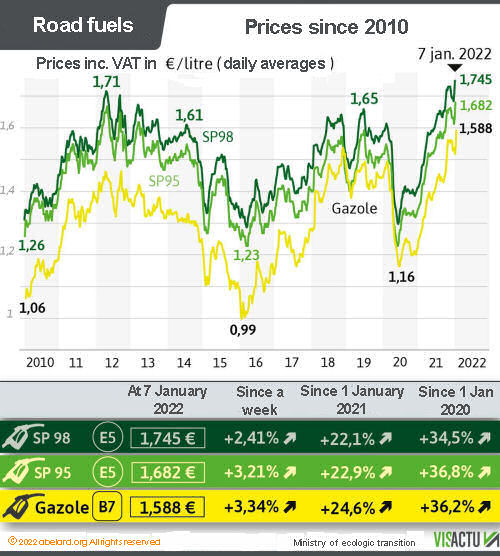
Fuel prices since 2020, VISACTU
In 2021, the price of a barrel of oil rose to more than 80 dollars, more than 70 euros. Global demand, and OPEC countries and others trying to keep production lower are both factors that lead to pump prices rising in the coming months. At the same time, if prices rise 'too high', consumers will avoid using their fossil fuel vehicles.
Of course, the ever increasing use of electric vehicles means the demand for fossil fuels will fall more and more. The conflicts between governments and companies wanting more revenue, while consumers look to ways to economise and the Earth forces a ginormous clean-up, makes for a see-saw of price increases and reductions.
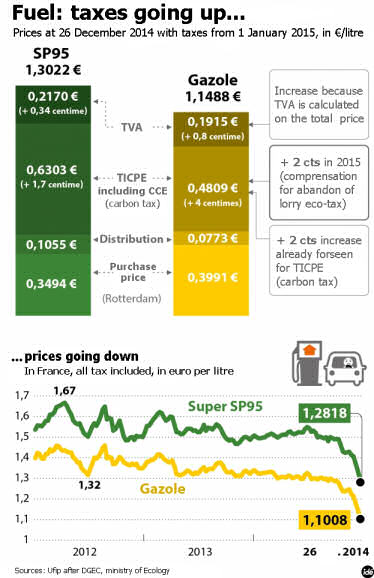
As crude oil prices fell in 2014, fuel prices went down 17.7% for gazole (diesel in English) and 14.9% for 95 octane petrol. Is this the real reason why the French government has jacked up the tax on fuels again, rather than the official line of reducing air pollution?
80% of French vehicles use diesel fuel, and being more efficient than petrol-fuelled cars, they use 20% less fuel. This makes rather hollow the claims that diesel is more polluting. (Of course, there are still a small number of older, highly polluting diesel vehicles about, but most prefer to trade those in for more efficient, and so less polluting, newer models.)
From the 1st of January 2015, all vehicle fuel prices will increase by 2.4 centimes per litre (including TVA), an increase being termed as carbon tax. In addition, gazole will increase by a further 2 centimes per litre, making the total increase for gazole 4.4 centimes per litre. It is said that the additional portion of increased tax is to compensate for the collapse of the ecotax or environmental tax on trucks.
The ecotax was to be charged on heavy goods vehicles [poids lourds - PL], the original plan being to register the movements of heavy goods vehicles on non-motorway roads, then send bills charged a per-kilometre road tax.
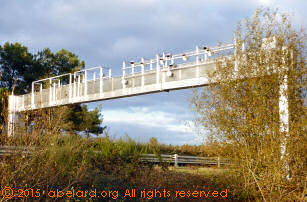
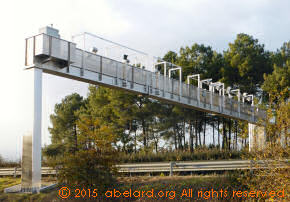
173 costly gantries with cameras had been erected to record the HGVs' movements, by detecting an obligatory black box installed in the lorry's cab. However, riots, road blocks and lorry go-slow demos [escargots - snails] on major roads during 2014 has forced the tax to be abandoned. Now the government is wary of upsetting commercial drivers further by targeting taxes solely at them.
 |
 |
The government had been in a legal battle with the gantry constructors over cancelling their contract. This specified the constructors were to receive a portion of the revenue to be generated in payment for footing the construction bill. The conclusion of this battle is that the French government will be paying out 839 million € in all, 580-590 million € by February 2015, then 30 million € annually for 10 years. This agreement includes paying the salary for a year of the 220 white-collar employees made redundant, many of whom had taken out mortgages on the basis of an excellent, government-funded salary. However, this may not be the end of the story as far as the company concerned, Ecomouv, says their receipts would have been more like 2 billion € over 10 years.
Update, February, 2015: The final amount to be repaid is just under a billion euro, at 958 million euro. Another reason why fuel prices will not drop to their current natural level.
The ecology minister, Ségolène Royal (n° 3 in the government and ex-long term partner of unpopular President François Hollande) has proposed that these unsightly gantries now be used by the gendarmeries and customs (at further cost), rather than be dismantled at a suggested cost of between 7 to 13 million euro.
Work notes
Where to stay
Michelin red guide…maps hotels and much else
email email_abelard [at] abelard.org © abelard,2021-2004 (05 april ) the address for this document is https://www.abelard.org/france/first-arrival.php |








 Just
to reassure you, it can become even more confusing. You
may see one of these skull-and-cross bone signs with a
number such as
Just
to reassure you, it can become even more confusing. You
may see one of these skull-and-cross bone signs with a
number such as 
 Other amusements you may run across: