Children and television violencelink to document abstractslink to short briefings documents link to news zone        news resources at abelard.org interesting site links at abelard's news and comment zone orientation at abelard's news and comment zone article archives at abelard's news and comment zone
site map Energy - beyond fossil fuelsLoud music and hearing damageWhat is memory, and intelligence? Incautious claims of IQ genes economics and money zone at abelard.org - government swindles and how to transfer money on the net   technology zone at abelard.org: how to survive and thrive on the web France zone at abelard.org - another France visit abelard's gallery

 back to abelard's front page 

Germans in France -

saint quentin cathedral

Ruins of Saint Quentin cathedral interior

Custom Search

france

new :

cathedral giants - Amiens and Beauvais

paying at the péage (toll station)

Germans in France
St. Quentin cathedral
Noyon cathedral
Reims cathedral
Cambrai cathedral
Soissons cathedral
Arras cathedral
cathedral destruction during the French revolution, subsidiary page to Germans in France

on first arriving in France - driving
France is not England

Click for motorways and motorway aires in France.

Transbordeur bridges in France and the world 2: focus on Portugalete, Chicago, Rochefort-Martrou
Gustave Eiffel’s first work: the Eiffel passerelle, Bordeaux
a dream unfulfilled - the transporter bridge [pont transbordeur], Bordeaux
a fifth bridge coming to Bordeaux: pont Bacalan-Bastide, a new vertical lift bridge

France’s western isles: Ile de Ré
France’s western iles: Ile d’Oleron

Click to go to pages about Art Deco at abelard.org

Click to go to 'the highest, longest: the viaduct de Millau'

Hèrmes logo

Pic du Midi - observing stars clearly, A64
Carcassonne, A61: world heritage fortified city

Futuroscope
Vulcania
Space City, Toulouse

Gustave Eiffel’s first work: the Eiffel passerelle, Bordeaux

a dream unfulfilled - the transporter bridge [pont transbordeur], Bordeaux

Ile de France, Paris: in the context of Abelard and of French cathedrals


France’s western isles: Ile de Ré

France’s western iles: Ile d’Oleron


Marianne - a French national symbol, with French definitive stamps

the calendar of the French Revolution


la belle époque

Grand Palais, Paris

Pic du Midi - observing stars clearly, A64

Carcassonne, A61: world heritage fortified city


Futuroscope

Vulcania

Space City, Toulouse


the forest as seen by francois mauriac, and today

places and playtime

roundabout art of Les Landes


mardi gras! carnival in Basque country

what a hair cut! m & french pop/rock

country life in France: the poultry fair

bastide towns

short biography of Pierre (Peter) Abelard

This page is a subsidiary page to Germans in France.

index
la basilique de st. quentin - st. quentin cathedral
 background facts 
end notes

related pages:

  • cathedrals - introduction: reading stained glass
  • gothic cathedral and church construction
  • cathedral giants - Amiens and Beauvais
  • stained glass development and technique
  • modern stained glass
  • history of ugly stained glass
  • analysis of a stained glass story window at Rouen
  • Lausanne rose window - photo-analysis
  • Dax and church iconography
  • Germans in France - their impact on cathedrals
  • map of northern France - cathedral towns and war zones
  • la Basilique de St. Quentin - St. Quentin cathedral

    [Note this building is not the seat of a bishop, so it cannot rightly be called a cathedral. It is a basilica that holds the relics of St Quentin.]

    Building la Basilique de St. Quentin was began in 1195 and continued for 300 years. The city was besieged in 1557 by the Spanish. In 1871, St. Quentin was captured by the Germans during the Franco-German War.

    Germans occupied the city on 28th August 1914, after which there were many battles with Allied troops fighting in this locality during 1914, 1917 and twice in 1918. One British soldier here was the war poet Wilfred Owen. St Quentin was finally liberated on 1st October 1918.

    On 15th August 1917, the cathedral was set on fire and by the next afternoon all that was left was the outer walls. German newspapers claimed that the fires had been started by French gunfire. However, the 15th was relatively calm in this region with few bombardments. On the other hand, German troops had been seen pillaging the city of St. Quentin, including their officers being party to wholesale removal of stolen goods, including coal, factory equipment, wine and mattresses (for wool).

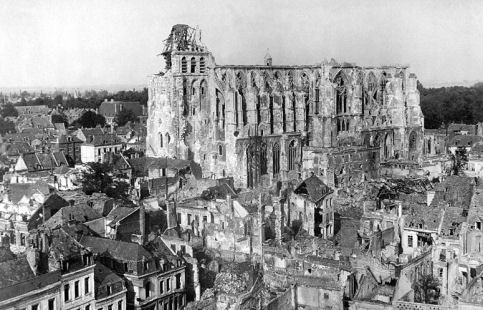
    By 1918, the cathedral was almost completely destroyed, except the exterior walls.

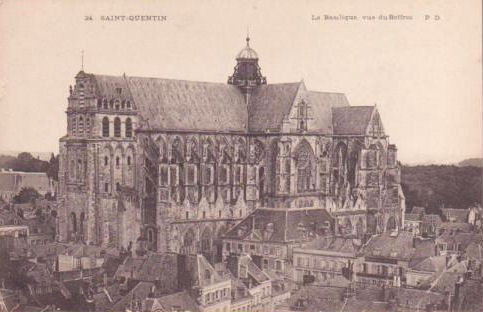
    St. Quentin, la Basilique before the First World War
    St. Quentin, la Basilique before the First World War


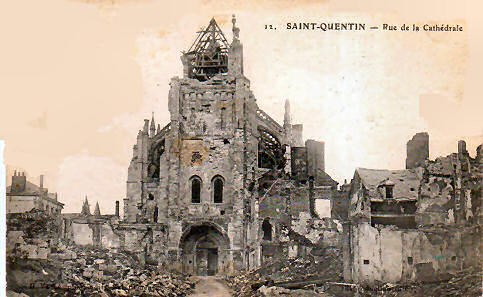
    Quentin, la Basilique, after 14 October 1918
    St Quentin, la Basilique, after 14 October 1918


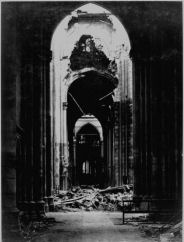
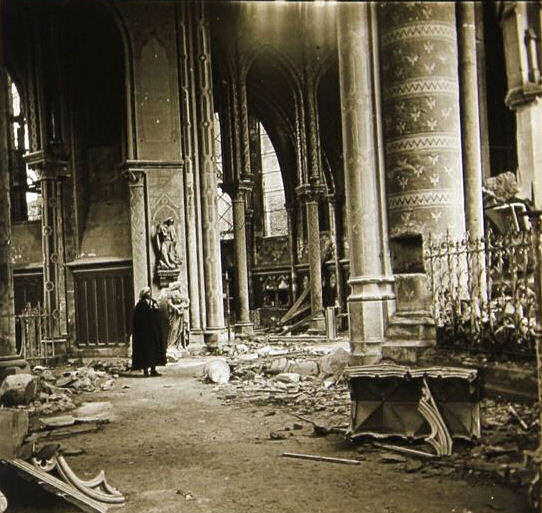
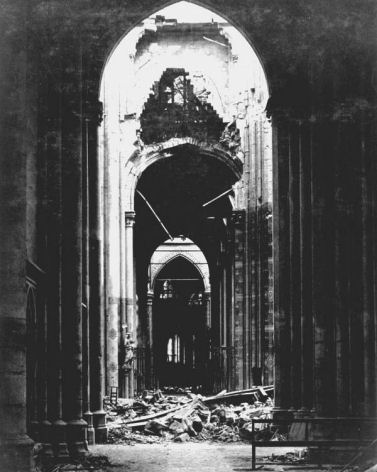
    Ruins of the interior of St Quentin cathedral
    Ruins of the interior of St Quentin cathedral
    Photographer: Pfc. William B. Gunshor, 18 October, 1918

    The damage to the cathedral was considerable: the vaulting of the central nave had collapsed completely, the flying buttresses were partially destroyed, there were numerous breaches in the walls and buttresses, while some masonry threatening to collapse could precipitate large falls, and the state of the bell tower was particularly worrying.

    After the war, the Basilique de St. Quentin was restored.

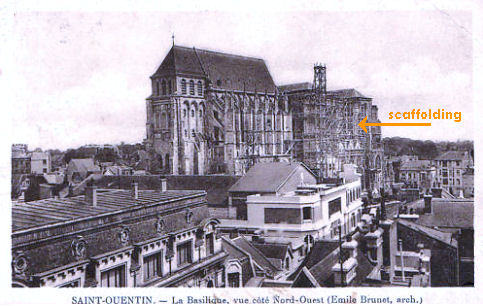
    Scaffolding on the South transept as the Basilique de St Quentin was restored
    Scaffolding on the South transept as the Basilique de St Quentin was restored
    [Note: the view appears to be of the south-west side]

    The task of restoration was given to Emile Brunet, chief architect of the Historic Monuments Service, sometimes known as “the cathedral man” for his knowledge of ancient building techniques. At first, German prisoners of war cleared about 3,000 cubic metres of cut stone and rubble. Unfortunately, not being adequately supervised, they further damaged carvings and decorations. The most urgent consolidations of masonry was done by specialised workers, parts from damaged sculptures being put aside carefully for later restoration.

    In order to protect the stone of the building from the weather until the roof was replaced, a temporary framework of eaves was placed on the top of the remaining walls, onto which 5,000 square metres of fibro-cement and Ruberoid sheeting was spread.

    The restoration took twenty-five years.

    click to return to the France Zone home page


    advertising
    disclaimer

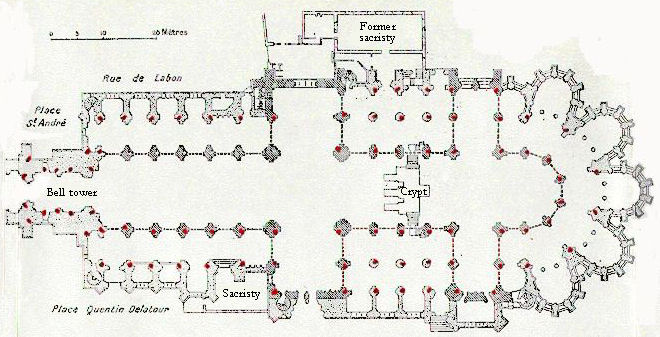
    Floor plan of the Basilique de St Quentin
    Floor plan of the Basilique de St Quentin, drawn by Emile Brunet.
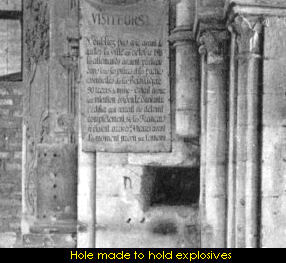
    The red dots mark 93 bore holes made by the Germans for holding explosives in order to destroy the building.
     
    Background facts
    Saint Quentin Saint Quentin coat of arms approximate population : 55,407
    average altitude/elevation : 82 metres
    cathedral dimensions
    length : 123 metres
    width : 52 metres
    nave height : 34 metres

    Marker at abelard.org

    Some reference keywords/tags:
    cathedrale,
    france,germany,basilica,basilique,1870,1914,1940,invasion,occupation,cathedrale,Saint Quentin,Emile Brunet,Canada,St Gervais,St Protais,Smil of Saint Quentin,Smiling Angel,l'Ange,le Sourire de Saint Quentin,

    end notes

    1. Wilfred Owens , born 8th March 1893, Oswestry, Shropshire; died 4th November 1918 in Ors, France while attempting to lead his men across the Sambre-Oise canal at Ors. Owens was awarded the Military Cross posthumously, for bravery in October 1918 by seizing a German machine-gun and using it to kill a number of Germans.

      Wilfred Owens is a respected war poet, his two best known poems being “Anthem for Doomed Youth” and “Dulce et Decorum est”. He was encouraged by Seigfred Sassoon, another war poet and author, to publish his only book of poetry, Poems by Wilfred Owen.

      Seigfred Sassoon’s Memoirs of an Infantry Officer describes his service on the Western Front and his disillusionment with war. Sassoon also wrote war poems.


    email abelard@abelard.org

    © abelard, 2010, 29 May


    all rights reserved

    the address for this document is http://www.abelard.org/france/germans_in_france-stquentin.php